


Recently, a former Trump cabinet secretary played Pent Up, a new Riskgaming scenario we are launching today. The game is one of our faster and easier salon experiences, and it simulates the Pentagon’s budget process and the intricate tradeoffs and politics of spending for new but higher-risk tech versus tried-and-true hardware that may date to the Vietnam War. This secretary was not having any of it. “This isn’t how government works,” they said bluntly to me. “No one — certainly not the president’s cabinet — sits down and strategizes the budget.”

One could chalk the dismissal up to being a cabinet member fighting the whims of Trump’s mercurial mind, which flits from one shiny object to another as Post headlines and Fox News hosts rotate on television. But the reality is both scarier and more banal: the secretary is right. In an ideal world, and certainly in Pent Up’s competitive play, there is an assumption that someone, somewhere is carefully balancing budget requests and trying to maximize national security capability against limited resources.
That assumption is wrong. As Dominic Cummings, the nerd-Machiavellian and one-time advisor to Boris Johnson in 10 Downing, once put it, “everyone thinks there’s some moment, like in a James Bond movie, where you open the door and that’s where the really good people are, but there is no door.” What you see is what you get, or as cyberneticist Stafford Beer might say, the purpose of a system is what it does. America is currently running on a continuing resolution funding the government through December 11.
The upshot of an idealistic game though is that it teases out some very important tensions in just 90 minutes. Pent Up highlights not just the balance between new and old tech, but also interagency infighting that can often be entirely orthogonal to American national security; the zero-sum nature of a fixed federal budget in an age of yawning debt; Congress’s penchant for projects that create jobs rather than capabilities; and finally, the fight to open up key defense platforms and making them interoperable rather than keeping them closed.
In short, we cover a lot of ground! Thankfully, federal procurement doesn’t have to be boring. Pent Up is centered around the meteoric rise of President Cormac Sterling, an itinerant guitar player who rises from poverty to the very pinnacle of power. He’s a maven at domestic politics, but struggles with the repeated foreign policy challenges that the world throws at the United States during his first term. You can watch an introductory video of his life in this fictional Spotlight documentary:
We’ve had the opportunity to play the game across a half a dozen full rooms, and nearly 200 players have played. Three conclusions stand out:
Players focused too much on expected value in their deliberations rather than thinking of a portfolio of projects to maximize mission success. That often meant high risk projects were relegated lower than was globally optimal for the table.
The game is played at tables of eight, and at every table, one to two players are much more Machiavellian than the others realize. As those devious strategists start to accumulate political points, other players turn on them. The infighting often intensifies.
Some of the worst outcomes came from tables that fully cooperated with each other. Aggressive — but ultimately flexible — negotiations were the key to some of the best outcomes we witnessed.
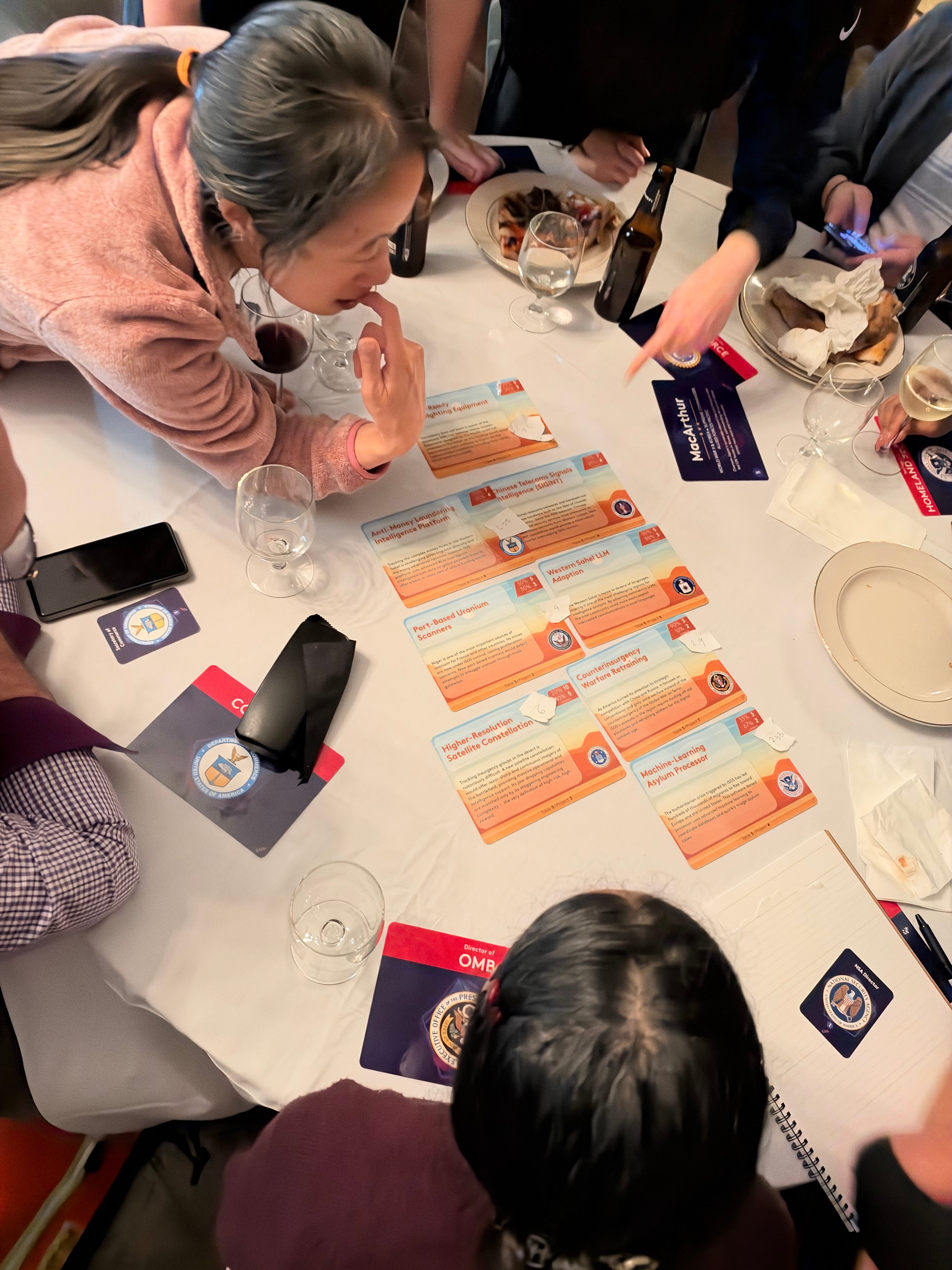
What will you learn? And will you beat everyone else? You can now play the game yourself. All of the materials for Pent Up have been added to the Riskgaming website, and the scoring software is open and available to use as well. I hope you enjoy the game.