Last week’s SF Tech Week Riskgaming event was the most popular one Laurence Pevsner and I have ever hosted: more than 1,200 people signed up for just 50 spots in our final private runthrough of Laurence’s Dead Reckoning game on European space sovereignty.
We are very sad more couldn’t participate, but there’s an upshot: we are releasing Dead Reckoning to the public today. All the materials you need to play (including the admin software) is now available online, entirely for free.
That means you don’t need to wait for us to host if you missed our game last week — you can just get a group of friends together anywhere in the world and start negotiating deals in a competitive game on Europe’s economic and security future. One professor at NYU Stern already took us up on this offer and incorporated it into the curriculum of his finance class.

Laurence designed the game for Chatham House’s annual defense and security forum in the lead up to the IPO of SpaceX. Elon Musk’s company dominates global space launch capability today, despite Europe pioneering commercial space launch all the way back in 1979. What happened? A series of bad decisions, cost overruns and delays have turned Europe from a space leader into a space laggard, and the continent is now almost entirely dependent on SpaceX for deploying its commercial and military space payloads. Laurence wrote up the game’s thesis in an op-ed for The Financial Times and our researcher Yuma Kim wrote up some of his main findings as well for Riskgaming.
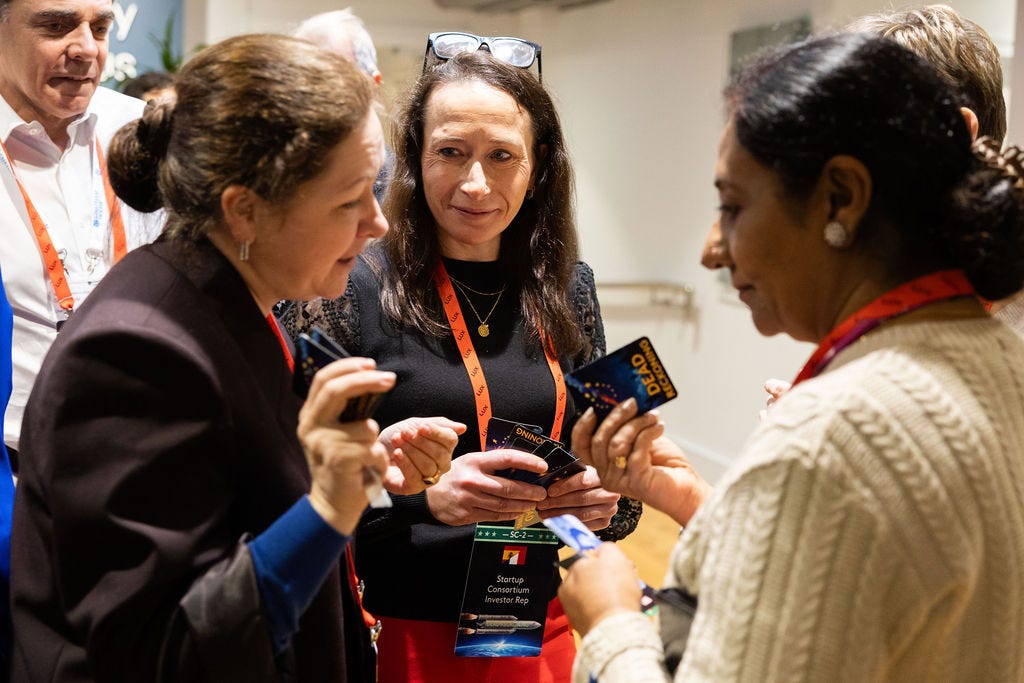
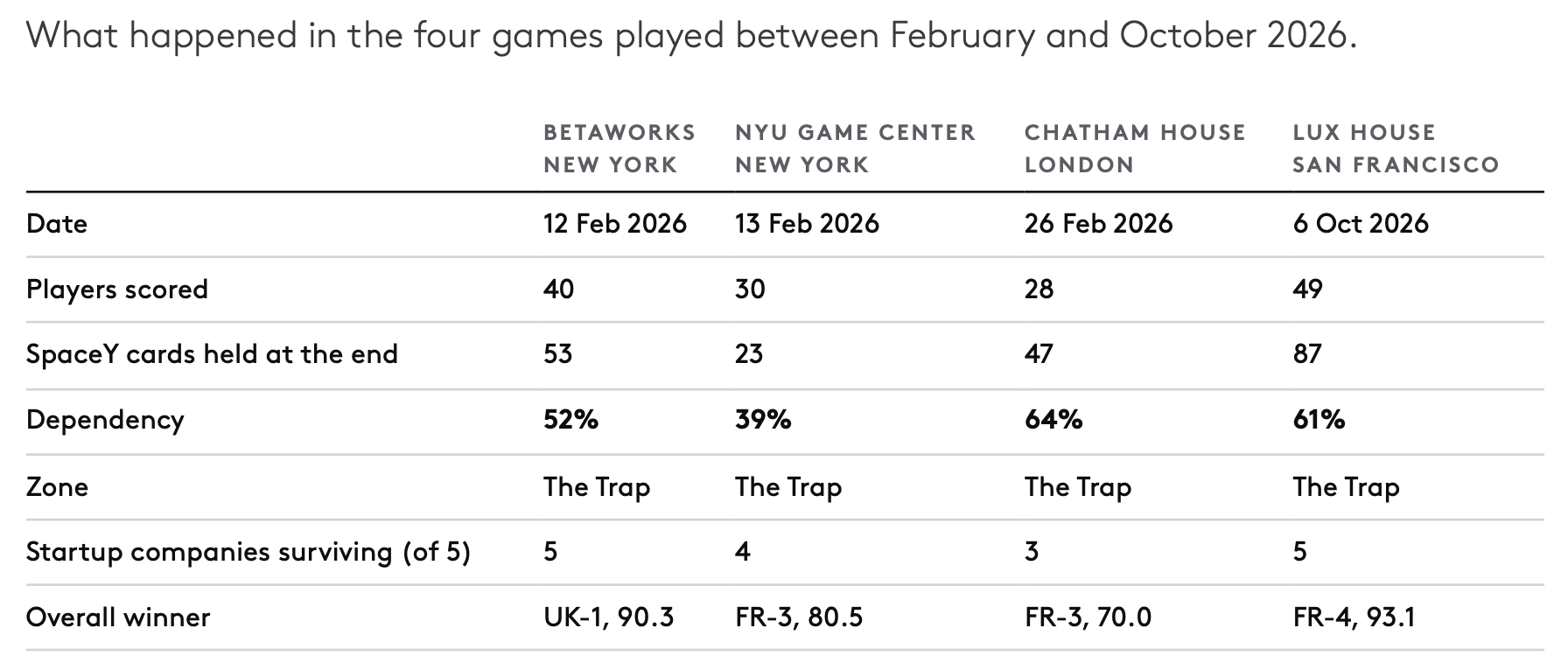
We’ve now officially hosted Dead Reckoning four times. What we’ve learned is that professional background has a tremendous influence on who wins — and who falls into the dependency trap. No group performed better than the graduate students of the NYU Game Center, whose cooperation was nonpareil. Worryingly, the lowest performance was among the very civil servants and military leaders we hosted in London, who also managed to drive almost a majority of the in-game startups into the ground. Here are the final results of our official runthroughs:
There are many more lessons we took away from the game, but perhaps the most important is that everyone loves to play realistic, policy-oriented games.
We’ll post our upcoming runthroughs here on Riskgaming, so make sure to stay subscribed to our (admittedly infrequent) Events newsletter. If Laurence or I can ever be helpful, please reach out directly!